REINFORCED

Reasons to choose concrete pipe

Strength

Precast Concrete pipe is the strongest pipe available and can be designed and tested to meet any loading condition. Unlike flexible pipe, concrete pipe has the majority of the required strength built into the pipe, and is much less dependent upon the installation of the pipe. Concrete pipe is manufactured per ASTM C-76 and AASHTO M 170 in strength classes ranging from Class I to Class V. These strengths are verified by a 3 Edge Bearing or D-Load test performed in the plant.

Durability

In today’s economic environment, designing for long term, sustainable project performance is imperative for the Engineer. Unlike some alternate pipe materials, concrete pipe has a proven track record of performance.  Concrete pipe will not rust, burn, tear, buckle or deflect, and is immune to most environmental elements. The United States Army Corps of Engineers has recommended precast concrete pipe for a design life of 70-100 years, and there are numerous examples of installations that have exceeded these parameters.

Value

Buried infrastructure is an asset that is financed and maintained by the public or private entities that invest taxpayer or shareholder dollars into the project. All of the costs of initial design, construction, material cost, inspection, and maintenance make up the total cost or “value” of an asset. Any asset that requires additional investment for repair, maintenance and/or replacement to maintain its’ value over the life of the asset actually adds to the owner’s cost of the asset. In order to make the proper initial choice of materials, the owner must truly understand the asset, and the value or cost of the asset over the design life. Design, installation, and inspection costs of flexible pipe are greater than comparable concrete pipe costs. The asset value of concrete pipe will not drop over the life of the project.

Environmentally Friendly

Comprised of the world’s most commonly used building materials, precast concrete infrastructure is quickly integrated into ecosystems. This is clearly demonstrated by the use of three-sided precast boxes used to accommodate the natural channels of streams at road crossings, and precast concrete pipe for storm sewers and outfalls in valleys and shorelines. Today, being recognized as a green material or product is growing in importance to many specifiers. Concrete pipe is suitable for LEED projects and it fits sustainable development. Unlike plastic pipe, concrete is produced with benign, natural materials. Manufacturing of concrete consumes less energy than plastic fabrication. It’s also recyclable and has little if any environmental impact.

Strength

Precast Concrete pipe is the strongest pipe available and can be designed and tested to meet any loading condition. Unlike flexible pipe, concrete pipe has the majority of the required strength built into the pipe, and is much less dependent upon the installation of the pipe. Concrete pipe is manufactured per ASTM C-76 and AASHTO M 170 in strength classes ranging from Class I to Class V. These strengths are verified by a 3 Edge Bearing or D-Load test performed in the plant.

Durability

In today’s economic environment, designing for long term, sustainable project performance is imperative for the Engineer.  Unlike some alternate pipe materials, concrete pipe has a proven track record of performance.  Concrete pipe will not rust, burn, tear, buckle or deflect, and is immune to most environmental elements.  The United States Army Corps of Engineers has recommended precast concrete pipe for a design life of 70-100 years, and there are numerous examples of installations that have exceeded these parameters.

Value

Buried infrastructure is an asset that is financed and maintained by the public or private entities that invest taxpayer or shareholder dollars into the project. All of the costs of initial design, construction, material cost, inspection, and maintenance make up the total cost or “value” of an asset. Any asset that requires additional investment for repair, maintenance and/or replacement to maintain its’ value over the life of the asset actually adds to the owner’s cost of the asset. In order to make the proper initial choice of materials, the owner must truly understand the asset, and the value or cost of the asset over the design life. Design, installation, and inspection costs of flexible pipe are greater than comparable concrete pipe costs. The asset value of concrete pipe will not drop over the life of the project.

Environmentally Friendly

Comprised of the world’s most commonly used building materials, precast concrete infrastructure is quickly integrated into ecosystems. This is clearly demonstrated by the use of three-sided precast boxes used to accommodate the natural channels of streams at road crossings, and precast concrete pipe for storm sewers and outfalls in valleys and shorelines. Today, being recognized as a green material or product is growing in importance to many specifiers.  Concrete pipe is suitable for LEED projects and it fits sustainable development. Unlike plastic pipe, concrete is produced with benign, natural materials. Manufacturing of concrete consumes less energy than plastic fabrication. It’s also recyclable and has little if any environmental impact.
PRODUCTS

Capacity and flexibility to serve a
broad range of needs

PRODUCTS

Capacity and flexibility to serve a
broad range of needs

OUR GOALS

It’s our job to make your project a success

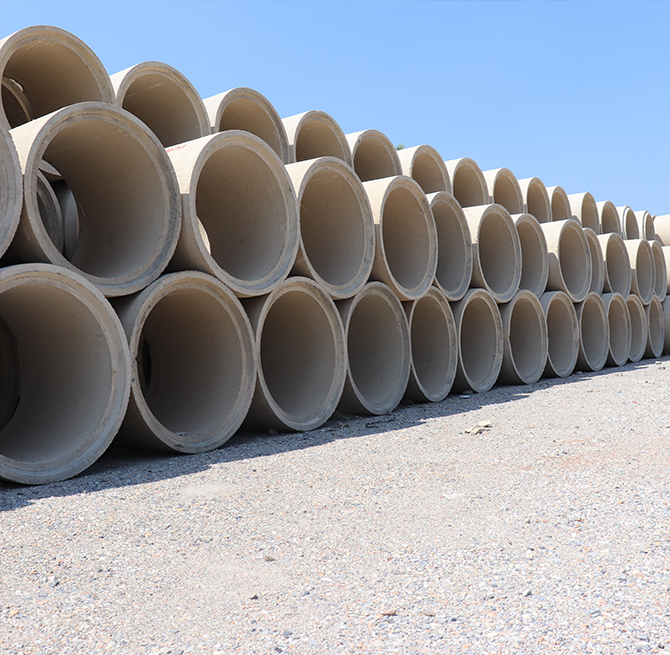
We stock ready-to-ship products in many standard sizes and configurations. And when your project calls for specific dimensions, joint types and strength ratings, we can easily re-tool production to meet your exact specifications.

Our location

Lorem ipsum dolor sit amet, consectetur elit. Quisque quis quam ipsum

m

Providing unparalleled access to premium concrete products while delivering top-tier service that clients can depend on.